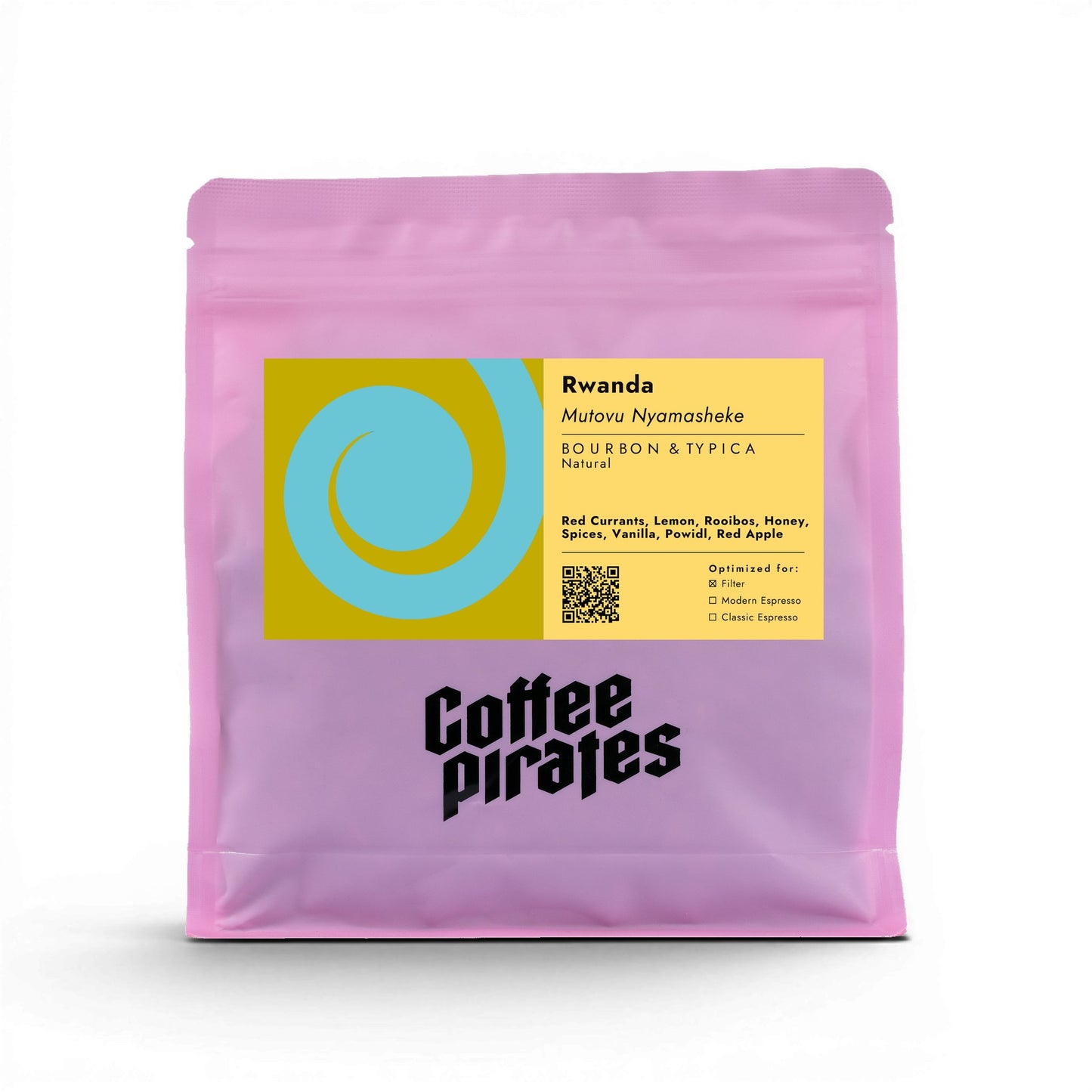

Rwanda Mutovu
Rwanda Mutovu


Verfügbarkeit für Abholungen konnte nicht geladen werden
Frisch geröstet für vollen Geschmack
Frisch geröstet für vollen Geschmack
Not sure how much coffee you need?
| Cups a week | 250g bag |
| 1-4 | 1 bag a month |
| 5-8 | 2 bags a month |
| 9-12 | 3 bags a month |
| 13-16 | 4 bags a month |
1 cup of coffee = a 240 ml serving based on a 1:16 brew ratio
For example, if your brew ratio is 1 to 16 (often expressed 1:16, or 1/16), then for every one part coffee, you use 16 parts water. In other words, to prepare 1 cup of brewed coffee you would use 15g of ground coffee and 240 ml of water.
Versand & Lieferung
Versand & Lieferung
Wir versenden täglich von Montag bis Freitag von unseren Standorten in Wien. Der Mindestbestellwert für jede Lieferung beträgt 20 €.
Lieferungen innerhalb Österreichs
4,50 € für Bestellungen bis 35,00 €. Bestellungen über 35,00 € werden kostenlos geliefert.
Lieferzeit: 2 - 4 Werktage
Lieferungen nach Deutschland
9,90 € für Bestellungen bis 70,00 €. Bestellungen über 70,00 € werden kostenlos geliefert.
Lieferzeit: 2 - 7 Werktage
Lieferungen in andere EU-Länder (außer Deutschland)
14,90 € für Bestellungen bis 70,00 €. Bestellungen über 70,00 € werden kostenlos geliefert.
Lieferzeit: 3 - 10 Werktage
Ethisch bezogen, fair bezahlt
Ethisch bezogen, fair bezahlt
Wir arbeiten eng mit Kaffeebauern und zuverlässigen Partnern zusammen, um faire Löhne und transparente Beziehungen zu gewährleisten.
Hinter dem Kaffee
Hinter dem Kaffee
Ruanda ist ein vielfältiges Land, reich an fruchtbaren Böden. Das gesamte Land liegt auf relativ hoher Höhe, der niedrigste Punkt liegt 950 Meter über dem Meeresspiegel. Im Osten prägen erdige Sümpfe und sonnige Savannen die Landschaft, während das Zentrum von sanften Hügeln geprägt ist. Der Westen hingegen liegt in der Ökoregion der Bergwälder des Albertine-Grabens mit einer reichen Tierwelt. Der Kivusee ist der größte See Ruandas und markiert die westliche Grenze zum Kongo. Als Teil der Albertine-Grabenberge ist diese Gegend im Allgemeinen nicht so heiß wie der Osten und bietet damit hervorragende Bedingungen für den Kaffeeanbau. Vulkane haben nährstoffreiche Böden geschaffen und die gesamte Region mit grünen Hängen gesegnet.
Ruandas erste Kaffeeexporte wurden 1917 von belgischen Kolonisten verwirklicht. Historisch wurde der Großteil der minderwertigen Produktion nach Belgien verkauft. Doch während Ruandas Wiedererstarken in den frühen 2000er-Jahren wurde Kaffee als Chance gesehen, das Land wieder auf die Beine zu bringen.
Die erste Waschstation wurde 2004 eröffnet und ebnete den Weg für den Anbau hochwertigen Kaffees. Heute wird Kaffee in jedem Teil Ruandas angebaut, da das gesamte Land auf erhöhten Plateaus liegt. Trotz seiner noch jungen Geschichte in der Produktion hochwertigen Kaffees überraschen ruandische Kaffees mit einer sanften Süße und komplexen Fruchtigkeit. Die wachsende Anerkennung, die diese Kaffees in der Spezialitätenszene erfahren, hat zur zunehmenden Bedeutung hochwertiger Kaffees geführt. In der Folge wurden zahlreiche Waschstationen errichtet, die Kleinbäuerinnen und Kleinbauern sowie ihren Erzeugnissen Zugang verschaffen.
Dennoch bleibt die Logistik eine der größten Herausforderungen, denn dieses Binnenland muss ganz Tansania durchqueren, damit seine Kaffees das Land verlassen können. Eine weitere Herausforderung speziell bei ruandischen Kaffees ist der sogenannte „Potato Defect“ (Kartoffelfehler). Ein harmloses Bakterium dringt in die Kaffeekirsche ein und verursacht einen kartoffelartigen Nachgeschmack in der Tasse. Durch ständige Überwachung und Qualitätskontrollen hat Ruanda dieses Problem in den Griff bekommen.
Bekannt als „das Land der tausend Hügel“, verfügt Ruanda zweifellos über die Höhenlage und das Klima, um außergewöhnlichen Kaffee anzubauen. Im letzten Jahrzehnt hat sich das kleine Binnenland zu einem Weltklasse-Ursprung für Spezialitätenkaffee entwickelt – und das aus gutem Grund. Die Waschstationen in den meisten Kaffeeregionen haben in neue Infrastruktur und Cupping-Labore zur Qualitätskontrolle investiert. Die meisten Kaffeebäuerinnen und -bauern sind Kleinbauern, die typischerweise zwischen 100 und 200 Bäume besitzen, sodass sich die Kaffees in der Regel bis zu den Waschstationen und Kooperativen zurückverfolgen lassen. Obwohl Ruanda auch Robusta produziert und exportiert, ist der Großteil seiner Erzeugung vollständig gewaschener Arabica.
Dieses Lot wurde von Kleinbäuerinnen und Kleinbauern in der Westprovinz erzeugt, die an den Kivusee und die DR Kongo grenzt. Sie liefern ihre Kirschen an die Kaffeestation Mutovu, die 2012 in der Gegend von Nyamasheke gegründet wurde. Das aus Bourbon und Typica zusammengesetzte Lot wurde natürlich (natural) aufbereitet. Die Kirschen wurden an der Waschstation angenommen und in Wasser geschwemmt, um leichtere, minderwertige Kirschen zu entfernen. Nach dem Schwemmen wurden die Kirschen von Hand verlesen, um unreife, grüne Kirschen auszusortieren. Schließlich wurde der Kaffee auf erhöhten Trockenbetten ausgebreitet und in der Sonne getrocknet.
Tasting Notes: Rote Johannisbeeren • Zitrone • Rooibos • Honig • Gewürze • Vanille • Powidl • Roter Apfel